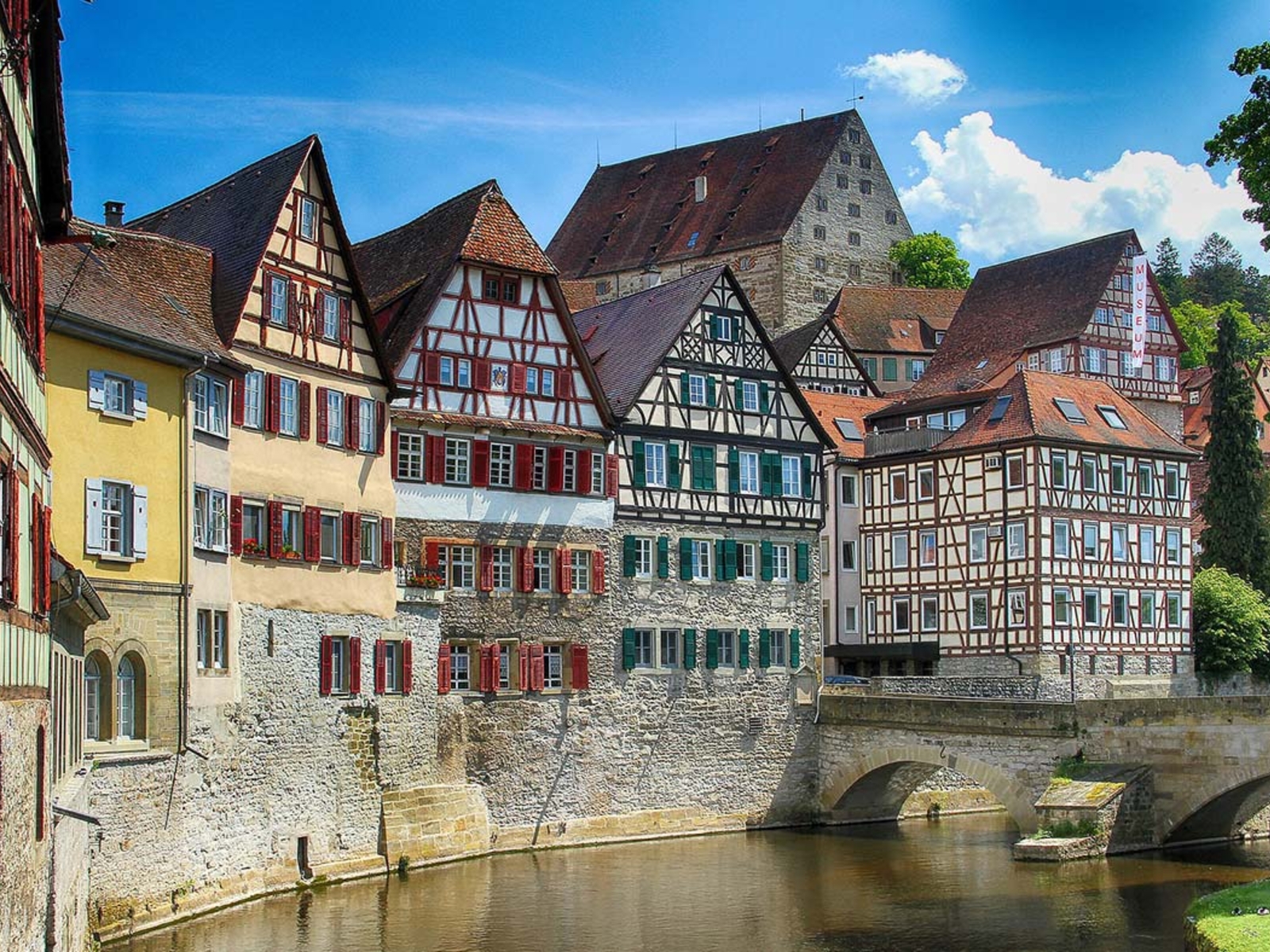
Welcome to Schwäbisch Hall
**Schwäbisch Hall is a picture-perfect town. Its beautifully preserved historic center provides the ideal setting for art and culture.**
Schwäbisch Hall has made a name for itself with its extraordinary
venues for the arts.
A church staircase serves as a theater stage, and a church interior as
an art museum.
The former Staufer town
gained prosperity in the Middle Ages through the salt trade. A stroll through
the winding alleys of the old town reveals this in many of the houses.
The market square, in particular, is an architectural gem.
All architectural styles from Romanesque to Rococo are represented there. On
its eastern side lies the imposing grand staircase of the magnificent
Gothic hall church of St. Michael.
In the summer, the 53
steps transform into a breathtakingly steep open-air stage with
a unique atmosphere. Theatergoers celebrate the magnificent
productions under the night sky. The audience experience at the “New Globe” on a
cooking island is also extraordinary. It was modeled after Shakespeare’s Globe Theatre on
the Thames. The three-story circular
open-air theater can host performances both open-air and under a roof.
But on four days a year,
the entire city becomes a giant stage. That’s when Schwäbisch
Hall celebrates one of the most beautiful local festivals in the state, the Cake and
Fountain Festival. It centers on the tradition of salt boiling.
Historical reenactments, a public salt-boiling demonstration, and
an XXL cake are the highlights. Those who want to experience tradition just outside
the city walls should visit the Wackershofen Open-Air Museum.
Here, farmhouses and craftsmen’s houses from the 16th to the 20th
centuries.
Art lovers flock to
the modern Kunsthalle Würth. In its annex, the
Johanniterkirche, old masters
are on display. Visitors gaze in awe at the
ethereal beauty of the Madonna of the Protective Mantle. It was painted by Hans
Holbein the Younger from 1525. The Hällisch-Fränkische Museum
is also part of this outstanding
cultural landscape. Admission to all three museums is free. That, too, is
extraordinary. But typical of Schwäbisch Hall.
Source: DZT Knowledge Graph