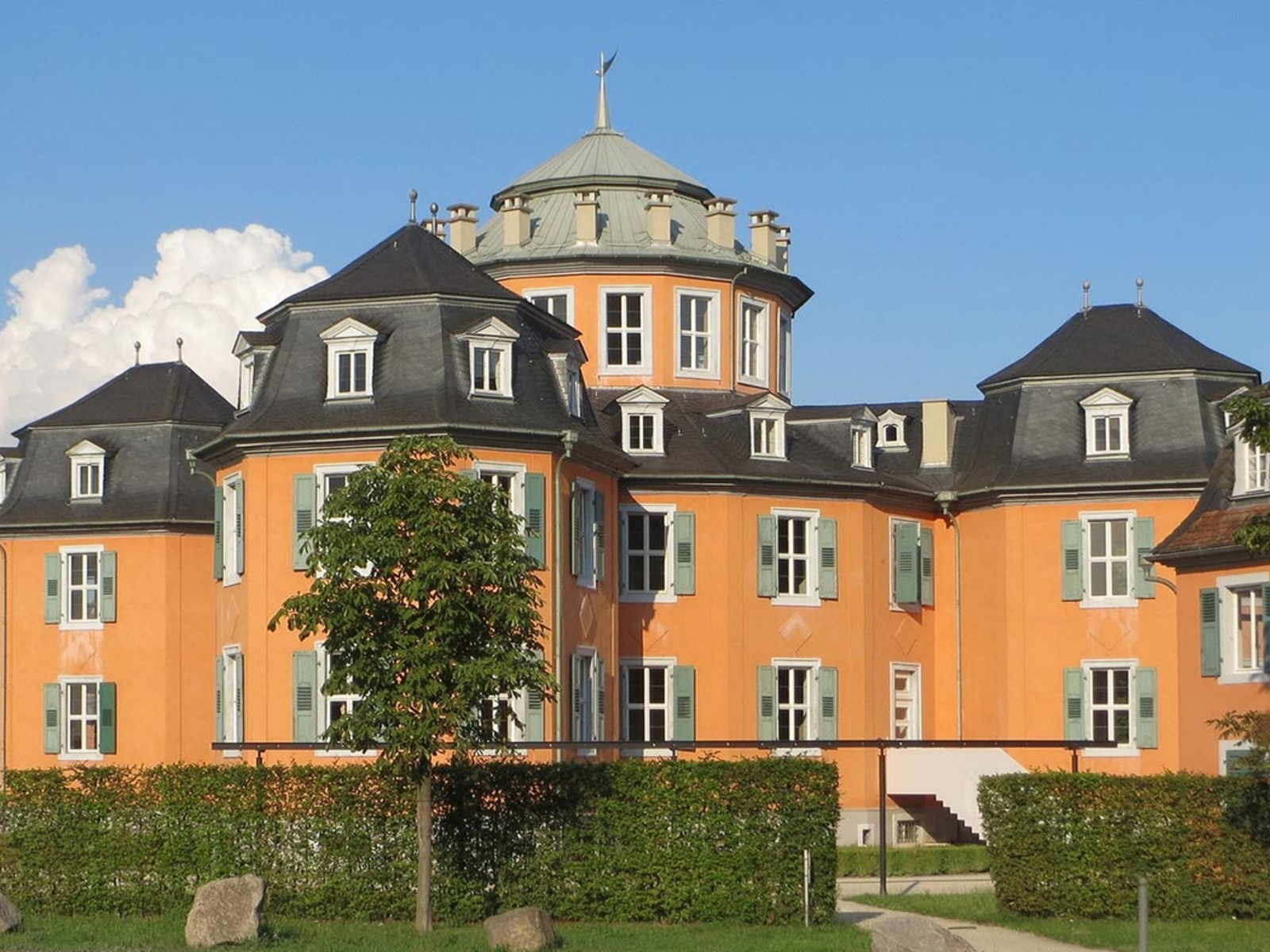
Welcome to Eremitage Waghäusel
Originally founded as a hunting lodge for Damian Hugo von Schönborn, Prince-Bishop of Speyer, the Hermitage was later partially rebuilt and has now been stylishly renovated, featuring a Baroque exterior and Art Deco interior.
The Hermitage, with its castle and park in Waghäusel, was founded by the Prince-Bishops of Speyer in the first half of the 18th century as a retreat for religious practices and relaxation through hunting.
From 1837 to 1997, the Baroque ensemble was part of the factory grounds of what was once Germany's largest sugar factory.
In 1997, after the factory closed, the city of Waghäusel acquired the entire site, including the castle complex. Since the beginning of 2014, renovation work on the central building has been completed and the Hermitage is gradually being opened to the public. The special appeal of the Hermitage lies in the positive tension between the Baroque exterior architecture and the interiors, which were redesigned in the style of the 1920s.
In addition, the outdoor area was redesigned in the summer of 2016. In addition to a large festival grounds, a park was created based on the original Baroque plans. There are four museum rooms in the central building. Visitors have the opportunity to experience the themes of "Architectural History of the Hermitage," "Baden Revolution," "Wagbach Lowlands," and "Waghäusel Sugar Factory" as part of booked guided tours. Admission is only possible via a booked guided tour.
Source: DZT Knowledge Graph